





How Long Does Fat Transfer Last?
Enhancing body contours and refining the shape of specific areas is often achieved through fat transfer—a versatile, minimally invasive cosmetic procedure used by many patients seeking a more balanced, natural-looking appearance. But how long a fat transfer lasts can vary based on several important factors, including technique, patient health, and lifestyle.
At Defyne, we prioritize the latest scientific innovations alongside the artistry of cosmetic enhancement to deliver personalized results that truly align with each patient’s unique goals. This includes our Enhanced Viability Fat Transfer (EVFT) approach, which helps support lasting results.
If you would like to discuss this with one of our experts, our consultation process is designed to help you understand which treatment options are best suited to achieving your desired goals.
What Is Fat Transfer?
Fat transfer—also called autologous fat grafting—is a cosmetic procedure in which a surgeon gently removes excess fat cells from one part of your body (the donor site), purifies it, and reinjects it into areas that need more volume or contour.
Because the material comes from your own body, it’s naturally biocompatible, feels soft and lifelike, and offers the dual benefit of slimming one area while enhancing another. This makes fat transfer a popular, minimally invasive alternative to implants or synthetic fillers for patients seeking subtle, long‑lasting, and natural‑looking results.
The fat transfer procedure is commonly used in several body areas:
- Breasts: in breast augmentation or to correct breast tissue asymmetry
- Face: helps restore volume around the cheeks, under the eyes, lips, jawline, or chin
- Buttocks: as part of procedures like the Brazilian butt lift, to create fuller, rounder contours
- Abdomen: to support tummy tucks or liposuction, smoothing irregular areas
- Hands: to counter the effect of aging on hand tissue
- Arms: to help define the triceps and biceps area
Along with enhancement procedures, fat transfer is also used as part of reconstructive surgery, to repair damage from trauma or cancer therapy, for example.
How Long Does Fat Transfer Last?
To understand how long fat transfer lasts, it is helpful to understand the science behind the procedure. Moving unwanted fat cells from one part of the body to an area that would benefit from more volume sounds straightforward. However, some variables can affect success rates.
Understanding Fat Graft Survival
Fat cells that are transplanted to a new area of the body do not have their own blood supply. New blood vessels must form. Some of the fat cells successfully gain a new blood supply, while some do not survive. Fat cell “take rates” after grafting range from 30%-80%.
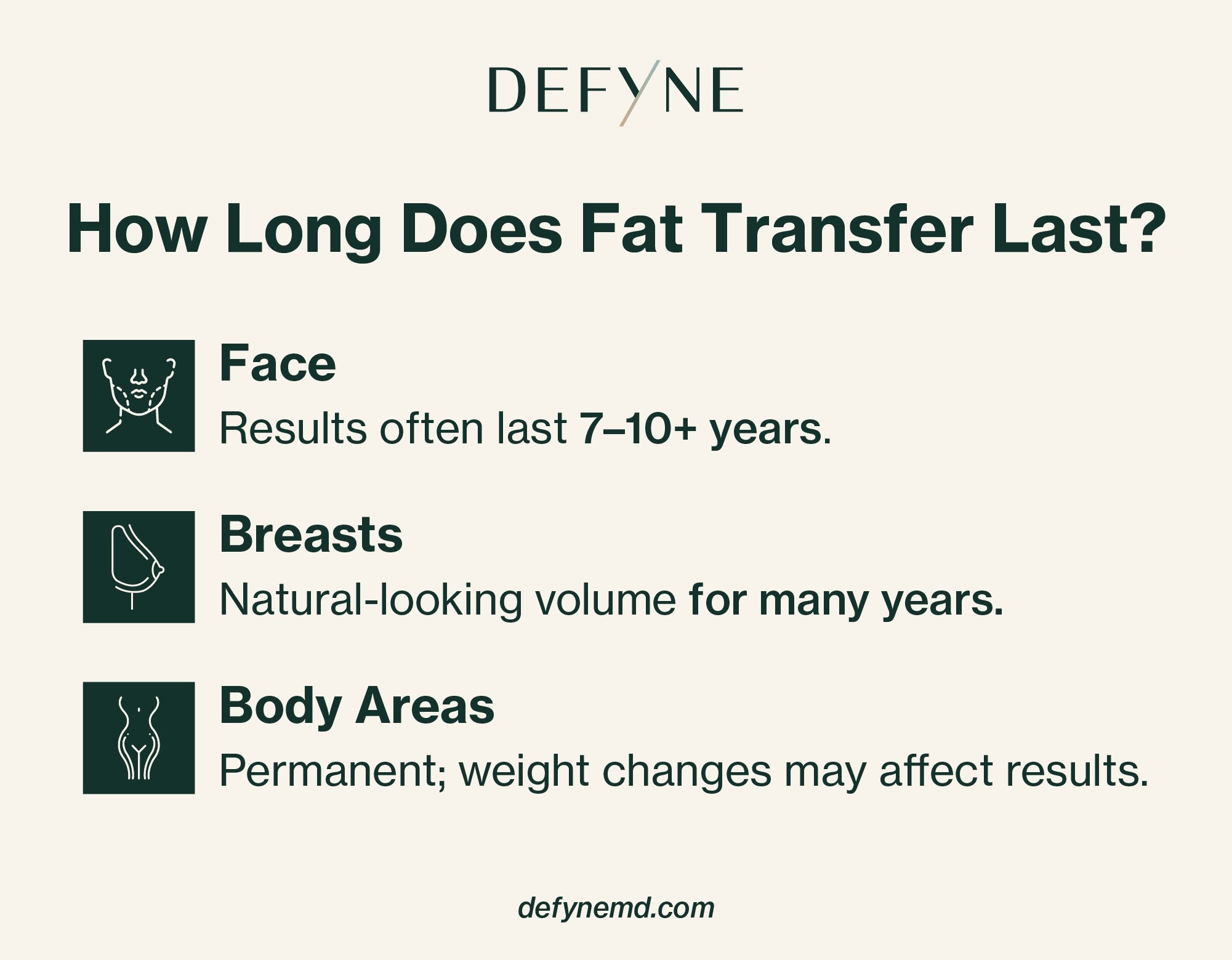
This variability in fat graft survival depends on several factors:
- The surgical technique: how fat cells are harvested, processed, and injected can all impact success.
- The volume of the fat transfer: larger volumes of fat cells transferred can result in lower success rates.
- Patient health and lifestyle: smoking and poor nutrition impact blood vessel growth and healing, and health conditions like diabetes can also impact success. People who gain weight or lose weight after surgery may also alter fat transfer results.
Fat Transfer Longevity Based on Body Area
Another element of fat transfer longevity is the location of the fat transfer. For example, because the face has a good blood supply, fat transfer success rates are usually higher in this area.
Some common questions about typical fat transfer success rates based on body area include:
How long does fat transfer last in your face?
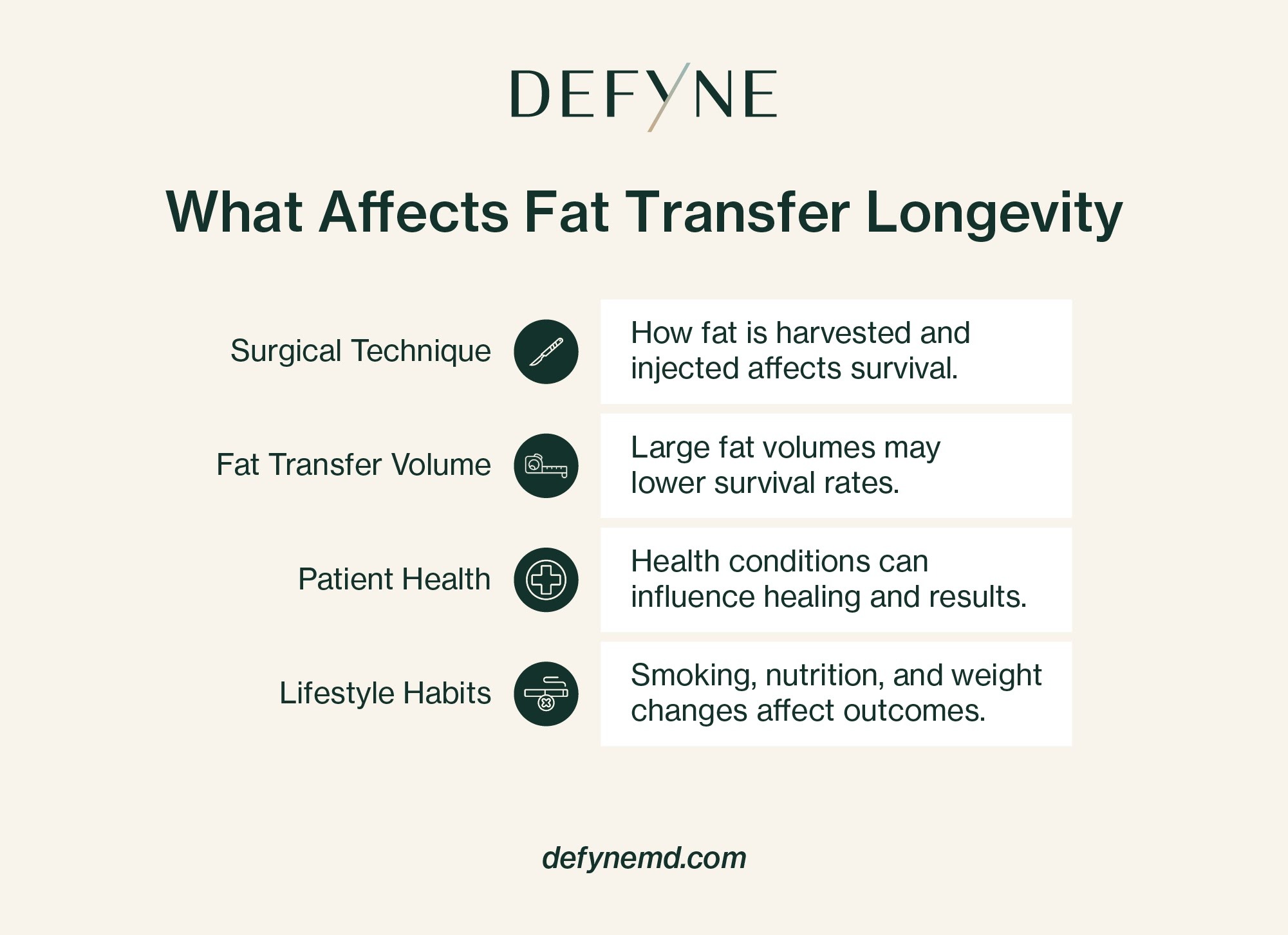
Fat transfer to the face is one of the longer-lasting options, with results being described as semi-permanent to permanent, often lasting 7-10 years or beyond.
Does fat transfer to the breast last?
Clinical evidence suggests that breast fat transfer after 5 years remains stable. Although natural fluctuations in weight and the aging process can affect natural breast tissue and alter size and shape, fat transfer to the breast can produce positive results for many years and offers an alternative to traditional breast implants in some situations.
How long does fat transfer last in other body areas?
Overall, fat cells that survive the transfer process become permanent in whatever part of the body they were used for fat grafting. Fat expands or shrinks with weight changes; natural aging still affects the area over time. Most patients report long-term satisfaction with their results.
What to Expect During Recovery
Because fat transfer is a minimally invasive procedure, recovery is generally quicker and more comfortable than patients might expect from traditional surgery. Most of the healing occurs within the first six months, though the initial downtime is relatively brief.
In the first 24 hours after your procedure, it’s normal to feel tired and to experience mild swelling or bruising around both donor sites and the treatment area. Compression garments are commonly used on the donor area and, sometimes, on the breasts to accelerate healing and help maintain the shape of the newly transferred fat.
Most patients can return to normal activities within 1 to 2 weeks, with full recovery typically occurring 3 to 4 weeks after surgery. Light exercise, such as walking, is generally fine during the first week, but more strenuous activity should be avoided until your surgeon gives the go-ahead.
Other lifestyle choices during recovery also matter. You should avoid nicotine for four weeks before and four weeks after surgery, and if excess fat was removed from your lower abdomen, sleeping on your back is recommended. You can usually shower 48 hours after the procedure, but baths and submersion in water should be avoided until the incisions are healed, which typically takes four weeks.
Maintaining healthy habits during this period, such as staying hydrated, eating a nutrient-dense diet, and avoiding smoking, supports blood vessel growth and can positively affect how well the transplanted fat cells settle into their new location. Your surgeon will provide specific aftercare guidance tailored to the type of fat grafting procedure you’ve had.
What Makes Defyne’s Fat Transfer Process Different?
At Defyne, fat transfer is performed by a board-certified surgeon using Enhanced Viability Fat Transfer (EVFT), a method in which harvested fat cells are refined and stabilized with the surfactant P188 to protect cell integrity.
By using these advanced techniques, we significantly increase graft survival, achieving uptake rates of approximately 80% or higher, compared with those typically seen with conventional fat grafting. The result is more reliable fat retention and longer‑lasting, more consistent outcomes.
Procedures where this approach can be used include:
- True Shape Breast Augmentation
- True Form Breast Lift
- True Curve BBL (Brazilian Butt Lift)
- Cellulite Treatment
- Facial Fat Grafting
Is Fat Transfer Right for You?
A good candidate for fat grafting is typically someone who is in good health, has enough donor fat, maintains a stable weight, has realistic expectations, and can commit to proper aftercare. This procedure offers a natural alternative to synthetic fillers and other procedures.
Defyne’s board-certified plastic surgeons can help evaluate whether this would be the right choice for improving contours or volume in select areas. Book your consultation with Defyne and explore this natural, lasting enhancement option.
Contact Us
Request a Consultation
Are you ready to take the first step toward defining your destiny and achieving your best look yet? At Defyne, our board-certified plastic surgeons are skilled in performing both surgical and non-surgical procedures, achieving individualized, natural-looking results. Contact Defyne today to schedule your consultation appointment.