





What is Capsular Contracture? Signs, Symptoms, and Treatment Options

Capsular contracture is one of the most common complications following breast augmentation and can significantly affect long‑term implant outcomes. Understanding capsular contracture, how and why it happens, what symptoms to watch for, and the treatment options available is important for those who are considering breast augmentation surgery or who are post-augmentation.
Defyne emphasizes anatomy‑based, research‑driven care and is the only practice in Arizona participating in the Study of P4HB Scaffold in Treatment of Capsular Contracture (STANCE).
If you’re experiencing firmness, tightness, breast shape changes, or pain after breast implants, you may qualify for the STANCE Clinical Study at Defyne. Contact us to learn more.
How Defyne Approaches Capsular Contracture
Defyne practices a research-based, biology‑aware, long‑term‑focused philosophy regarding capsular contracture. Our involvement in the STANCE study reflects a commitment to durable outcomes rather than short‑term fixes.
The P4HB Scaffold is designed to reduce recurrence and improve long-term outcomes in patients undergoing breast surgery for capsular contracture. Participants receive:
- Structured follow‑up
- Multistage clinical evaluation
- Compensation at designated milestones
Research on recurrence reduction and new therapeutic techniques supports this approach. As the only Arizona practice in the STANCE clinical trial, we’re proud to offer access to this cutting‑edge treatment.
Who May be a Good Candidate for the Study?
The study is targeting women who have previously had breast augmentation and who:
- Have been diagnosed with capsular contracture, or
- Believe they may have symptoms consistent with capsular contracture
The best way to know if you qualify is to schedule an evaluation with the Defyne team.
What Is Capsular Contracture?
Breast augmentation typically involves various types of implants, such as saline implants or silicone implants, to enhance breast appearance. Like any surgical procedure, breast augmentation carries risks, and capsular contracture is a common possible complication, occurring in 10%-20% of cases.
Normally, scar tissue forms a soft, flexible capsule around all implants, which is the body’s natural reaction to the breast implant. Capsular contracture occurs when this capsule of fibrous scar tissue becomes abnormally tight, thick, or restrictive, distorting implant feel and breast appearance.
Advanced cases of capsular contracture can cause physical discomfort and pain.
Why Capsular Contracture Occurs
There are many risk factors that cause capsular contracture. It is important to know that capsular contracture is not caused by patient behavior—it is not always possible to avoid it.
Everyone’s body heals in its own way, and factors like biology, inflammation, surgical techniques, and implant characteristics all play a role.
Even with excellent care, capsular contracture can still happen, while plenty of breast augmentation patients never experience it at all.
Risk factors for developing capsular contracture include:
- Previous radiation therapy to the breast.
- Bacterial biofilm on the implant that causes low-grade chronic inflammation.
- Implant placement—subglandular placement (above the muscle) carries a higher risk than placement beneath the muscle.
- Surgical complications like hematoma or surgical site infection.
- Implant type—non-textured breast implants and larger implant sizes tend to be linked with a higher risk.
- Genetic predisposition and previous history of developing capsular contracture; once you have a capsular contracture, it is 2-3 times more likely for it to occur again.
Capsular contracture becomes a concern once it changes how the breast feels, looks, or moves, which is why getting it checked early by a plastic surgeon is important before symptoms progress.
Capsular Contracture Symptoms
Catching capsular contracture early is important because it opens the door to less‑invasive, non‑surgical treatments that work best before the condition progresses.
Early intervention—using medication, massage, or ultrasound—can help address firmness, discomfort, or changes in breast shape before the scar tissue becomes too rigid, often preventing the need for surgery.

Early Signs of Capsular Contracture
- Progressive breast firmness
- Persistent internal tightness/sensation of pressure (mild discomfort)
- Positional shift of the breast implant, especially upward
- New asymmetry in projection or contour in the affected breast
- Contour changes (less mobility of the tissue, unnatural settling with movement)
Advanced Indicators of Capsular Contracture
- Persistent hardness
- Visible distortion
- Breast implant edge visibility
- Pain or unrelenting tightness
Stages of Capsular Contracture (Baker Grades)
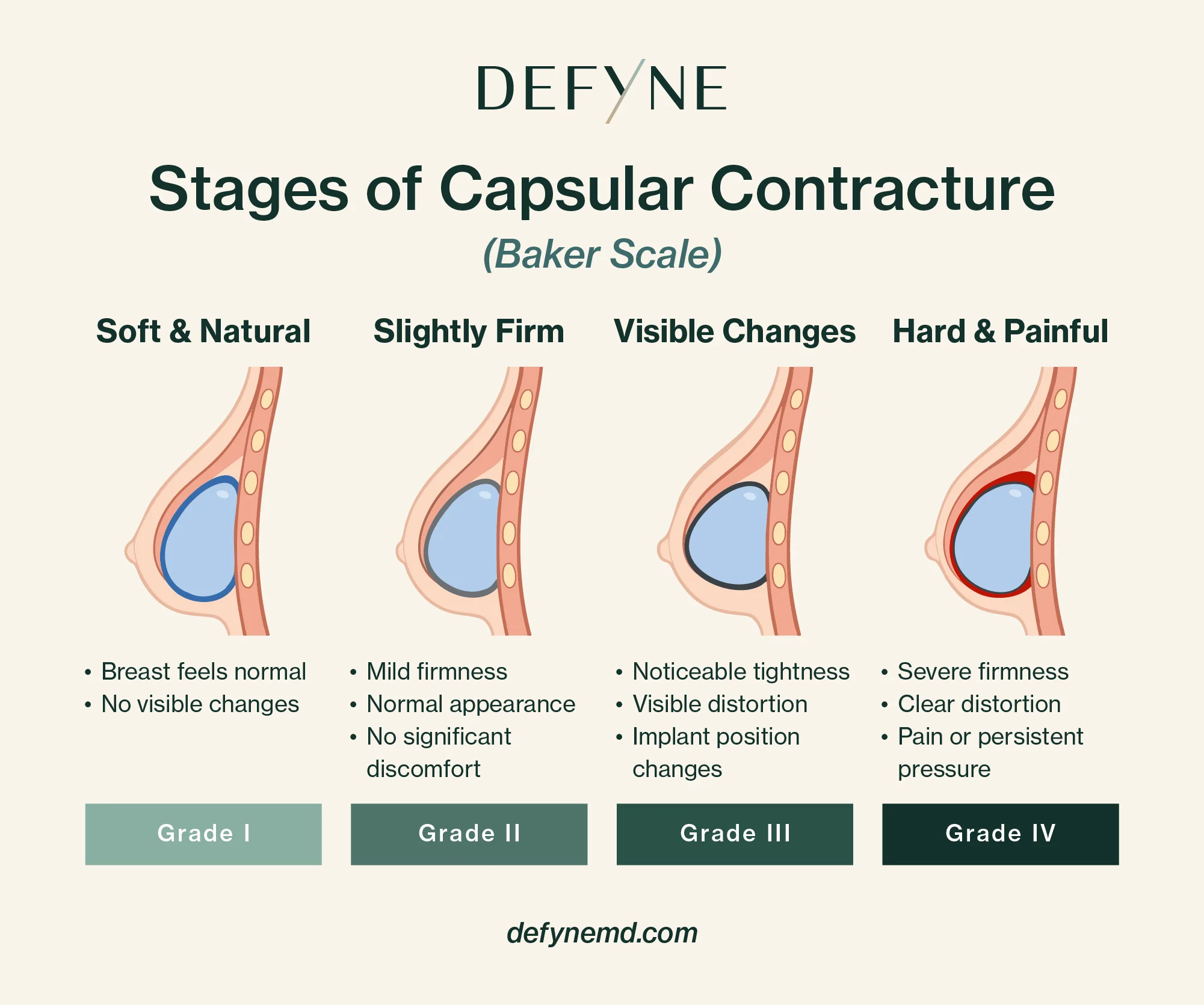
To help define the degree of capsular contracture, plastic surgeons use the Baker Scale. This helps guide the correct treatment approach.
- Grade I: Soft, natural breast
- Grade II: Slight firmness, normal appearance, and sensation
- Grade III: Firmness + visible distortion, patient feels tightness/pressure
- Grade IV: Firm, painful, and clearly distorted
Capsular Contracture Treatment Options
Fortunately, capsular contracture can be corrected. In the early stages of developing capsular contracture, interventions can delay or reduce progression. There are a few non-surgical ways to do this:
- Massage therapy at the implant site
- Ultrasound therapy (e.g., the Aspen rehabilitation technique)
- Medications: anti-inflammatories, antibiotics (if appropriate), steroids, and leukotriene inhibitors (e.g., montelukast)
Surgical Management
When capsular contracture has not responded to therapy or is more advanced (Baker Grade III to IV), surgical management is necessary. Surgical treatment involves releasing or removing the tightened breast capsule, known as capsulectomy.
The existing breast implant is also typically removed and replaced with a new implant, sometimes in a different position, such as under the muscle. This can be done at the same time as the capsule is removed, or in a second revision surgery after healing has occurred.
Are You Dealing with Capsular Contracture?
If you’ve been diagnosed with capsular contracture or have noticed firmness, tightness, changes in position, or discomfort after breast augmentation surgery, Defyne can help.
Contact us to check eligibility for this study and to discuss treatment options with one of our board-certified plastic surgeons.
Contact Us
Request a Consultation
Are you ready to take the first step toward defining your destiny and achieving your best look yet? At Defyne, our board-certified plastic surgeons are skilled in performing both surgical and non-surgical procedures, achieving individualized, natural-looking results. Contact Defyne today to schedule your consultation appointment.