





Brow Lift vs Blepharoplasty: Which Is Right for You?

One of the first places the effects of fatigue and aging show up is your face—often concentrated around your eyes and forehead. If first impressions matter, the youthful and rested appearance of this area is crucial to your self-esteem.
Surgical approaches to tackling these concerns include a brow lift or blepharoplasty, but how do you know which is right for you? These procedures are often compared because both can affect how open, rested, and youthful the eyes appear.
In this article, we will describe key differences to help you understand your options.
Considering a brow lift or blepharoplasty?
Schedule a consultation with Defyne Plastic Surgery to learn which approach fits your anatomy and goals.
What a Brow Lift Treats
The most common reason for brow sagging (also called brow ptosis) is age-related changes. Brow descent can create the appearance of drooping eyelids even when the eyelid skin itself is not the main problem. It can also give the impression that a person is tired or stern-looking.
A brow lift, or brow lift surgery, repositions the brow, softens forehead lines and wrinkles, and helps improve the appearance of the upper one-third of the face, including the area around the eyes. This helps restore a more youthful, alert expression.
There are multiple approaches to brow lift surgery, including endoscopic, temporal, direct, and coronal brow lifts. The best technique depends on hairline, degree of brow descent, skin quality, and goals.
What Blepharoplasty Treats
In simple terms, blepharoplasty is eyelid surgery. During this procedure, excess skin, muscle, and fat are removed or repositioned.
Blepharoplasty can address the upper or lower eyelids, or both. Upper eyelid blepharoplasty can improve redundant upper eyelid skin that rests on or near the lashes, while lower eyelid blepharoplasty can improve under-eye bags, puffiness, and lower eyelid bulging.
Blepharoplasty can restore a more youthful, rested appearance and even improve everyday activities like reading or driving when sagging skin is affecting vision.
Brow Lift vs Eyelid Surgery: How to Tell Which One You May Need
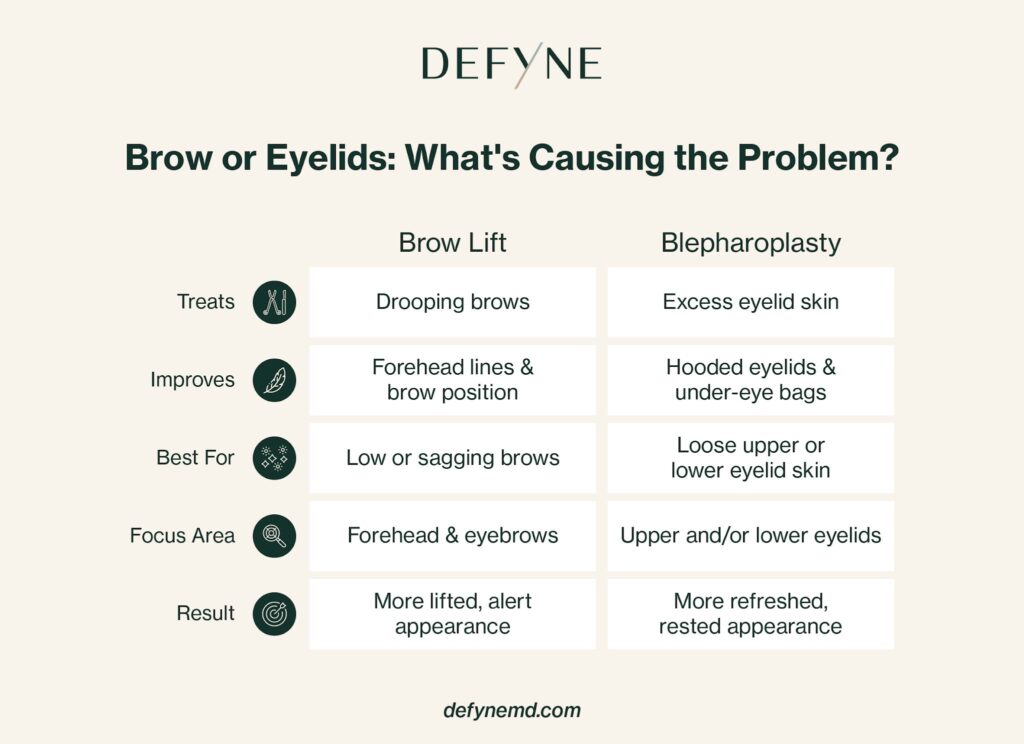
The difference between brow lift and blepharoplasty is not about which procedure is “better”; it is about whether the source of hooding is the eyebrow position, eyelid skin, or both. In some instances, a consultation with a board-certified plastic surgeon may determine that both procedures are necessary to achieve the desired results.
A simple test to determine whether your brows or eyelids are the primary source of sagging is the pencil test: place a pencil horizontally across the brow area at the upper orbital rim (right at the eyebrow).
Squint your eyes; if the eyebrow pulls down below the pencil, a brow lift can help correct sagging. If the eyebrow position doesn’t move, blepharoplasty may be the more targeted procedure.
When Brow Lift and Blepharoplasty Are Performed Together
Many individuals have both brow descent and true excess skin of the upper eyelid. In these cases, a combined procedure may create a more balanced result than treating either area alone.
For example, performing blepharoplasty without recognizing brow ptosis may leave eye hooding unresolved, or brow sagging might become more noticeable. Conversely, lifting the brow without addressing redundant eyelid skin may not fully refresh the eyes.
It’s important to seek individualized planning tailored to your unique needs and goals, helping ensure success and natural-looking results.
Recovery, Downtime, and What to Ask During Consultation
Downtime and total recovery time vary by procedure, technique, anesthesia, and whether brow lift and eyelid surgery are combined. Along with a careful physical examination and discussion of your goals, your surgeon can answer questions about:
- Incision placement and scarring
- How long the results can be expected to last
- Typical recovery timeline and return to work
- Side effects such as swelling and bruising after the procedure
- How to manage symptoms during recovery
The Defyne Approach: Minimally Invasive, Customized Upper-Face Rejuvenation
At Defyne, we focus on innovative, minimally invasive techniques for facial rejuvenation and offer individualized surgical planning. After identifying whether brow lift or eyelid surgery (or both) is necessary, there are several options available:
Endoscopic Brow Lift: Minimally Invasive
This procedure is ideal for patients with mild to moderate brow drooping. This approach uses a small camera (endoscope) and specialized instruments to lift the brow and release muscle tension, made possible by 4–5 small incisions hidden behind the hairline, minimizing visible scarring.
Temporal Brow Lift
This technique is often performed at the same time as blepharoplasty. Short incisions are placed in the temples behind the hairline, resulting in minimal visible scarring. It can subtly elevate the outer brow and reduce crow’s feet.
Pretrichial (Hairline) Brow Lift
Ideal for high foreheads, this technique is moderately invasive and uses an incision along the frontal hairline. In addition to offering a noticeable lift to the brow, it can help shorten the forehead.
Direct Brow Lift
By placing the incision just above the eyebrows, this technique offers precise control and brow shaping.
It can be helpful for older patients, those with prominent brows, or those who need revision or correction of asymmetrical brows. It is more invasive than other approaches and can leave a visible scar in some patients, depending on skin type and anatomy.
Coronal Brow Lift
A coronal brow lift uses a long incision that runs across the scalp from ear to ear, making it one of the more invasive brow lift techniques. Although it is performed less often today, it may still be recommended for patients with substantial brow drooping or for revision cases when less invasive methods may not provide sufficient correction.
This technique can create a significant lift, but it typically involves a longer recovery period. It may leave a more noticeable scar, though the incision is usually concealed within the hair.
Upper, Lower, and Double Blepharoplasty
If blepharoplasty is an appropriate option, traditional approaches include upper blepharoplasty (upper eyelid area), lower blepharoplasty (lower eyelid area), and double blepharoplasty, which creates a more defined upper eyelid fold for a more open, refreshed eye.
When desired, an epicanthal fold can be softened with an additional procedure called epicanthoplasty, which is sometimes performed at the same time.
Laser Blepharoplasty
Laser blepharoplasty is a variation of eyelid surgery that uses laser energy, most commonly a CO2 laser, to assist with tissue removal or resurfacing around the upper and/or lower eyelids. Because the laser can cut while helping seal small blood vessels, it may reduce bleeding, bruising, and swelling in appropriately selected patients.
Mid-Facelift with Blepharoplasty
In cases where the lower eyelid skin is lax, midfacial tissue may also require a lift. The mid-face lift with blepharoplasty combines the removal of excess lower eyelid tissue with redraping of midfacial tissue and fat grafting for a more complete refresh.
If you are comparing brow lift vs blepharoplasty, the most important next step is a personalized evaluation.
Contact Defyne to schedule your consultation and learn whether a brow lift, blepharoplasty, or combined procedure is right for you.
Contact Us
Request a Consultation
Are you ready to take the first step toward defining your destiny and achieving your best look yet? At Defyne, our board-certified plastic surgeons are skilled in performing both surgical and non-surgical procedures, achieving individualized, natural-looking results. Contact Defyne today to schedule your consultation appointment.