




Breast Implants vs. Fat Transfer Breast Augmentation

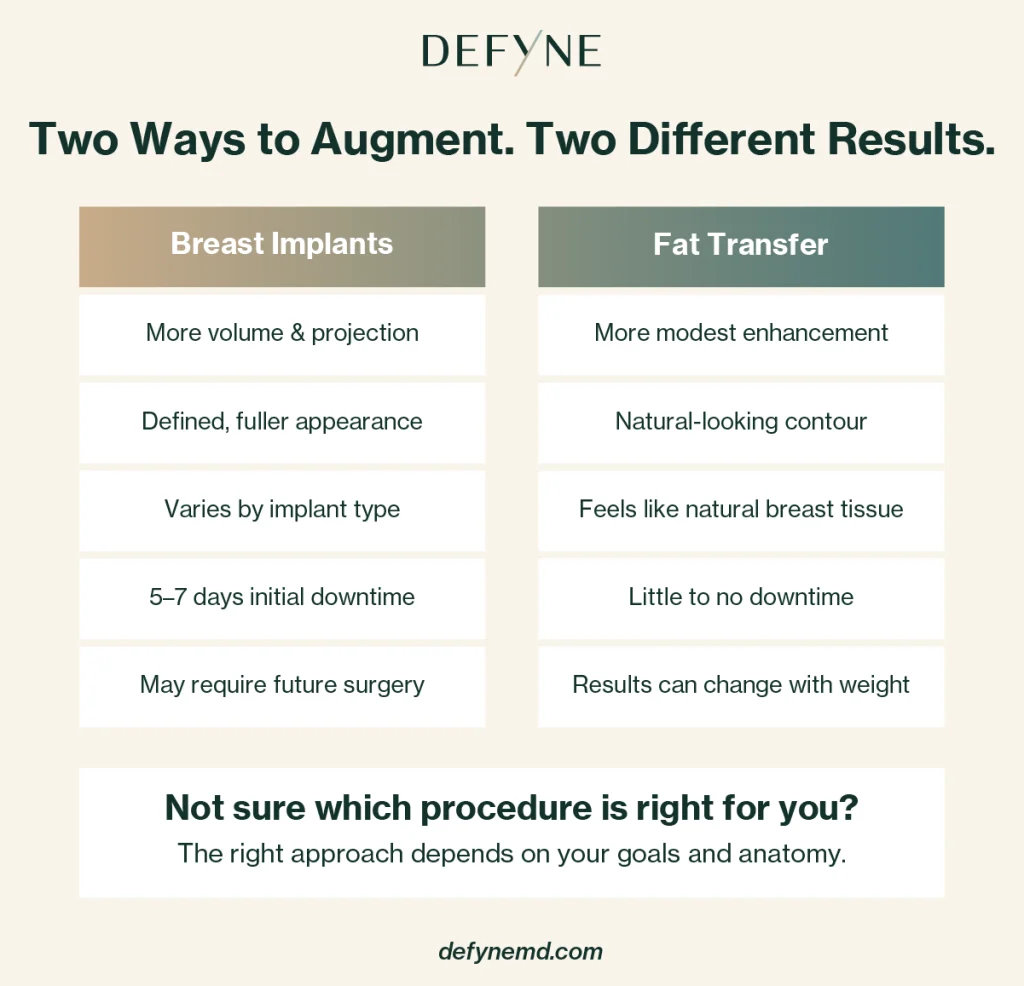
Breast implants generally offer a larger, more predictable increase in size and projection, while fat transfer uses your own fat for a more modest change and requires enough donor fat. Implants need ongoing monitoring and may require future surgery; fat transfer has variable retention and may need more than one session.
At Defyne, we’re dedicated to innovating aesthetic care, and that includes breast augmentation approaches. Schedule a consultation to compare traditional implants and Defyne’s minimally invasive True Shape Breast Augmentation based on your unique anatomy and goals.
How Each Breast Augmentation Approach Works
The traditional breast augmentation that most people are familiar with involves breast implants, with placement of a saline or silicone gel-filled implant beneath breast tissue or muscle through a surgical incision.
In the past two decades, however, the option of fat grafting for breast enhancement has evolved into a viable alternative to traditional breast implants. Fat transfer breast augmentation involves harvesting fat from one part of the body (“donor” fat), specialized processing of the harvested fat cells, and then reinjecting the purified fat into the area that needs enhancement.
At Defyne, fat transfer breast augmentation is done using our True Shape Breast Augmentation with Enhanced Viability Fat Transfer (EVFT), a pioneering approach to better fat transfer outcomes.
Breast Size, Projection, and Predictability
Like any aesthetic procedure, breast augmentation is not one-size-fits-all. Because individual goals and anatomy affect the choice of procedure as well as outcomes, it’s important to explore your options with a board-certified plastic surgeon with experience performing both.
Generally, breast implants offer a broader, more predictable range of volume and breast projection. Depending on the size of the implant, patients can expect to gain one to three or even more cup sizes.
Fat transfer’s final volume is limited by donor supply and graft survival, rather than a fixed volume like implants. Typically, a fat transfer can increase breast volume by around one cup size and is best suited for modest enlargement goals and/or contour refinement. A 2024 systematic review found that average fat graft retention rates are about 58%; EVFT retention rates are closer to 70-85%.
Look, Feel, Incisions, and Scarring
Traditional breast augmentation requires incisions that are large enough to place implants in the breast tissue. Whether those scars are visible depends on several factors, including surgeon expertise, placement technique, age, genetics, and skin tone.
In comparison, fat transfer breast augmentation is considered minimally invasive and requires smaller incisions, leaving no to minimal scarring.
The look and feel of traditional breast implants is also different from fat transfer augmentation. Patients can expect traditional implants to create a uniformly smooth and round appearance, with a defined upper breast “perkiness” or projection. The texture depends on the type of implant used (e.g., silicone implants vs. saline implants), ranging from firm to softer and more natural-feeling.
Fat transfer, in contrast, results in a more subtle, natural-appearing contour and definition, or fullness, of the breasts, and feels and moves just like natural breast tissue. It also does not carry the risk of rippling that traditional breast implants can sometimes cause.
Risks and Recovery Process for Breast Implants vs. Fat Transfer
There are some key differences in risks and recovery processes for breast implant surgery vs. fat transfer. Let’s examine both breast augmentation methods.
Risks of Breast Implant Surgery
Like any surgical procedure, breast implant augmentation carries risks such as bleeding, infection, delayed wound healing, scarring, asymmetry, pain, and temporary or lasting changes in breast or nipple sensation. Implant-specific complications may include shifting or malposition, visible rippling, rupture or deflation, and capsular contracture. Rare but serious concerns include breast implant-associated anaplastic large cell lymphoma (BIA-ALCL), an immune-system cancer reported more often with textured implants.
Risks of Fat Transfer Augmentation
Fat transfer risks include infection, bleeding or a hematoma (a collection of blood), pain, partial fat reabsorption, fat necrosis, oil cysts, calcifications, and contour irregularities. Discuss how future breast imaging will be interpreted and whether further treatment might be needed.
Recovery from Breast Implant Surgery
Because this is a more invasive surgical procedure, general anesthesia or twilight sedation is used for comfort. Patients return home the day of the procedure, and initial downtime is 5-7 days. Detailed aftercare instructions include how to use a supportive surgical bra to aid healing and reduce swelling. Most patients gradually return to normal activities over the following weeks.
Recovery from Fat Transfer Augmentation
Fat transfer may be performed under local anesthesia for selected patients, but anesthesia depends on the volume, donor areas, and combined procedures. Recovery includes both the breasts and liposuction sites.
Bruising, swelling, and discomfort may last several weeks, and the surgeon should give individualized return-to-work and exercise instructions.
Final volume develops over several months.
Differences in Long-Term Outcomes Between Each Approach
Breast implants are not lifetime devices, so patients may eventually need additional imaging or surgery to monitor, replace, or remove them. There is no fixed replacement date or guaranteed lifespan. For asymptomatic silicone gel implants, FDA labeling recommends the first ultrasound or MRI at five to six years, then every two to three years; symptoms can require earlier evaluation.
Fat that survives the initial healing period can remain long-term, but the final volume is variable, and further sessions may be needed.
Defyne’s advanced EVFT approach helps maximize the results of fat transfer for optimal retention. It’s important to know that surviving fat does behave like any other body fat and can change with weight, aging, pregnancy, or hormonal factors.
Which Procedure am I a Candidate For?
A consultation with a board-certified plastic surgeon can help you clarify your goals and understand your unique factors that impact the results of each procedure.
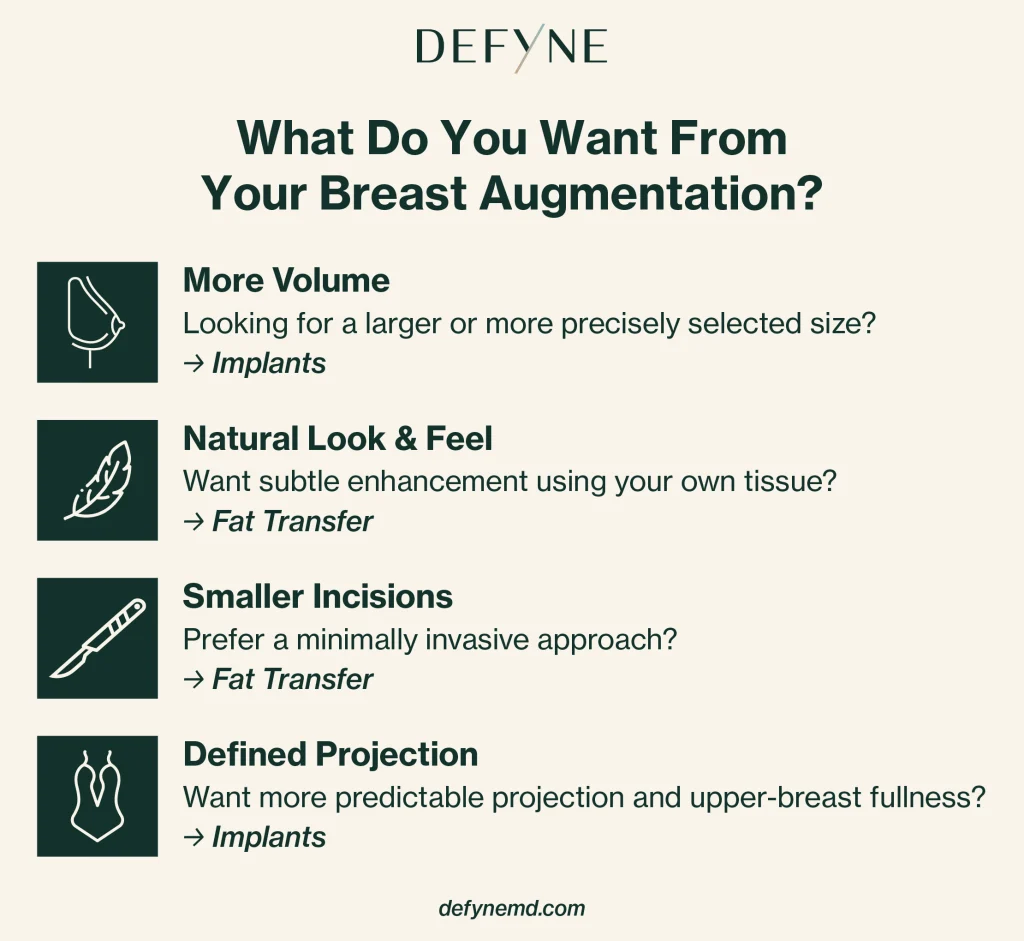
Generally, breast implant candidates are patients seeking a larger or more precisely selected volume who can safely undergo surgery and are willing to participate in future follow-up and revision surgeries. Patients with little body fat or minimal donor fat may also be better candidates for implants than fat transfer, after an individualized surgical assessment.
Fat transfer candidates are those who are seeking a natural alternative to breast implants, desire a modest change to breast size, have adequate donor fat for harvesting, and understand that not all fat transferred will be retained, with final results including shape and appearance settling over several months.
How Much is a Fat Transfer Breast Augmentation?
If you’re wondering about fat transfer breast augmentation cost, it’s important to know that factors like your location, surgeon experience, and combining other procedures with breast augmentation all affect the price.
The best way to determine your specific cost is to schedule a consultation and review your specific goals with a surgeon experienced in fat transfer breast augmentation.
Ready to Choose Between Breast Implants vs. Fat Transfer Augmentation?
Making the decision on how to approach breast augmentation is best done with support from an experienced plastic surgery provider, who can walk you through all the factors that are unique to your case.
At Defyne, our True Shape Breast Augmentation provides a cutting-edge alternative to breast implants for those who seek a more natural, implant-free approach to breast augmentation, with a treatment plan designed around your donor-fat supply, desired volume, and expected graft retention.
Schedule a personalized consultation with Defyne today to discuss traditional implants, True Shape Breast Augmentation, and whether EVFT is appropriate for you.
Contact Us
Request a Consultation
Are you ready to take the first step toward defining your destiny and achieving your best look yet? At Defyne, our board-certified plastic surgeons are skilled in performing both surgical and non-surgical procedures, achieving individualized, natural-looking results. Contact Defyne today to schedule your consultation appointment.