




How to Get Rid of Hip Dips

Hip dips are normal inward curves between the hips and upper thighs. Exercise cannot change the bone structure that helps create them, and no treatment can promise to eliminate them completely. For people who want a softer contour, liposuction around adjacent fullness, fat transfer, or selected injectable options may help after an individualized assessment.
While there are some options that can help correct hip dips, it’s important to have realistic expectations and to understand the potential outcomes of each. Let’s take a closer look at hip dips, what causes them, and how to fix them.
If you’re ready for an in-depth, personalized consultation with an experienced plastic surgery team, contact Defyne today for a consultation and discover your options for improving hip dips.
What Are Hip Dips, and What Causes Them?
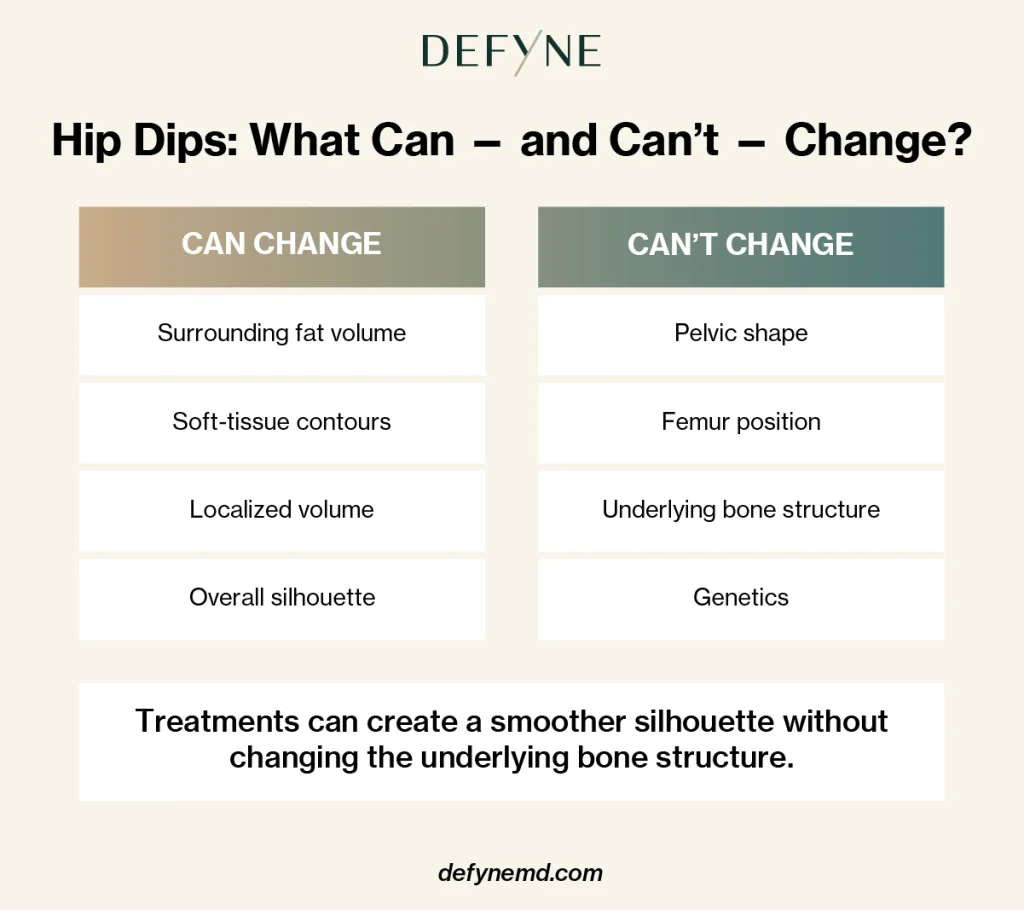
Also called “violin hips,” hip dips are inward curves that appear between the upper hip and thigh, resulting from normal variations in genetics and bone structure. Your pelvic width and shape, the position and angle of your femur (thigh) bone and greater trochanter (the bump on your outer thigh bone), your gluteal muscle and connective tissue structure, and fat distribution all combine to create the outline of your thigh and hip.
For some people, this results in slight indentations between the hip bone and thigh; for others, a more significant dip.
Hip dips are completely normal, occur across all body sizes and fitness levels, and are not an indication of impaired hip function or an anatomical problem. However, you can have a hip dip and have unrelated hip problems, so if you notice new or persistent hip pain, weakness, swelling, or trouble walking, you should let your healthcare provider know right away.
Can Exercise or Weight Loss Fix Hip Dips?
In an effort to improve hip contour, it might seem like hip dip exercises or weight loss could be a solution. But do they make a meaningful difference?
The reality is that while hip exercises like resistance training can improve your overall health and strengthen the muscles around hip dips, changing your overall silhouette to some degree, they do not change bone structure or other core anatomy, such as pelvic size.
Weight loss also changes overall body shape, but there is no way to create targeted weight loss that eliminates hip dips. Weight gain or loss can make hip indentations more or less noticeable, depending on how your body stores fat, but these changes are not predictable.
Lifestyle Changes and Hip Dips
Posture awareness can affect the appearance of hip dips, and focusing on clothing like high-waisted pants that create a smoother contour can help, too. However, if hip dips continue to frustrate you despite exercise, weight loss, or lifestyle changes, you may be interested in minimally invasive options to improve their appearance.
Liposuction for Hip Dip Treatment
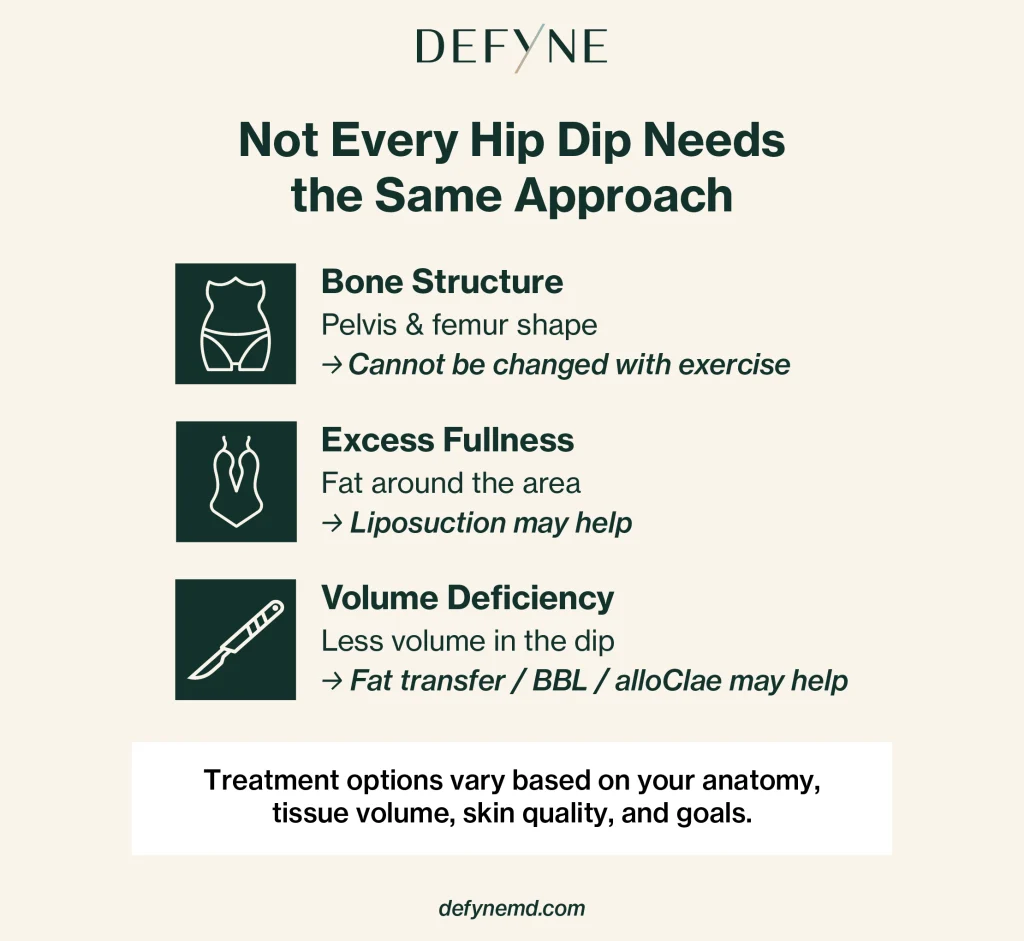
In some cases, liposuction may be recommended to selectively reduce contours and minimize the appearance of hip dips. Liposuction can be performed at the waist, flank, or outer thigh, creating a smoother transition from waist to thigh, and is a minimally invasive procedure.
Patients may be ideal candidates for liposuction to treat hip dips if they have localized excess fat, are at a stable weight, and have good skin elasticity. It’s important to know that although removing fat cells can be long-lasting, body contour can still change with weight fluctuations, aging, and changes in skin quality.
Liposuction risks include bleeding, infection, contour irregularities, changes in skin sensation or pigmentation, blood clots, and anesthesia-related complications. Risk depends on the extent of treatment, health history, and setting.
Adding Volume to Hip Dips with Fat Transfer or a BBL
When hip dips are caused by volume deficiency between the hips and thighs, a board- certified plastic surgeon may recommend either a targeted fat transfer procedure or Brazilian Butt Lift (BBL):
Fat Transfer for Hip Dips
With fat transfer, or fat grafting, excess fat from another part of the patient’s body is harvested, processed, and then transferred to an area that would benefit from enhanced volume. This minimally invasive procedure may be appropriate for individuals with sufficient excess fat who are at a stable weight and in good overall health.
The tight skin over hip dips can make this a challenging area for fat grafting, and some transferred fat is absorbed during healing. Final volume and retention vary. After healing, your surgeon may recommend a second fat-grafting session or discuss adding alloClae later. The manufacturer notes that alloClae has not been studied in combination with other treatments, so a staged plan requires an individualized discussion of benefits, risks, and uncertain results. Defyne uses Enhanced Viability Fat Transfer (EVFT) to maximize fat retention, increasing success rates to up to 80% compared with traditional fat grafting, which has retention rates of 30-40%.
BBL to Improve Hip Dips
While a fat transfer may be limited to the area of visible hip dips, a BBL includes a broader plan to enhance the silhouette of the buttocks, as well as using fat transfer.
Defyne’s True Curve BBL uses EVFT strategies to deliver a minimally invasive, scarless procedure that creates smoother contours and an hourglass silhouette.
BBL risks include contour irregularity, asymmetry, fat necrosis, infection, blood clots, and, rarely, fatal fat embolism.
For gluteal fat grafting, professional societies recommend injection only in the subcutaneous layer above the muscle fascia and real-time ultrasound guidance.
Discuss the surgeon’s credentials, facility, safety technique, and postoperative care.
Minimally Invasive Hip Dip Volume With alloClae
As an alternative to fat transfer, alloClae is a processed human adipose tissue allograft containing nonviable fat cells and supporting tissue components. A minimally invasive procedure, alloClae may improve body contours, address cellulite, and treat hip dips. It eliminates the need for fat harvesting when used as a standalone procedure. Some patients combine it with EVFT for further augmentation.
Early research is promising, but does not establish alloClae’s long-term human results. It can be a good fit for patients seeking modest, targeted contour refinement or who don’t have enough donor fat for transfer.
Risks include swelling, bruising, discomfort, nodules or cysts, infection, discoloration, hematoma, and allergic or immune responses; results and longevity vary.
How a Customized Consultation Guides the Choice
Defyne’s team can evaluate your skeletal proportions, skin quality, the location of fullness vs. deficiency, and donor-fat availability to support customized recommendations to treat hip dips based on your unique goals and factors. Medical history, medication use, prior procedures, desired degree of change, and recovery preferences all also impact the choice of procedure.
Some key concepts to weigh include:
- Liposuction may be most appropriate to reduce fullness adjacent to the hip dips, but not for those with significant volume deficits at the site of the dip.
- Fat transfer and/or BBL can add larger-volume contours when enough donor fat is available.
- alloClae can support localized, minimally invasive volume replacement without fat harvest.
Ultimately, it’s important to note that aiming for softer contours—not anatomical perfection—is necessary with hip dips. While these procedures can minimize their appearance, each approach has limitations, risks, and variable results. Liposuction and fat transfer can require weeks of activity restrictions, especially when combined with a BBL; injectable treatment may involve less downtime, but follow-up or touch-ups can still be needed; none can promise complete elimination.
If you’re ready to have a candid discussion of benefits, alternatives, safety, and expected outcomes of hip dip treatments, schedule a consultation today with Defyne and learn more about our clinical advancements in aesthetic care.
Contact Us
Request a Consultation
Are you ready to take the first step toward defining your destiny and achieving your best look yet? At Defyne, our board-certified plastic surgeons are skilled in performing both surgical and non-surgical procedures, achieving individualized, natural-looking results. Contact Defyne today to schedule your consultation appointment.