




Breast Augmentation After Weight Loss

Body contours often change in unexpected ways after a successful weight loss journey. When sagging breasts are part of these changes, breast augmentation after weight loss can restore both confidence and lost volume with implants or fat transfer.
If loose skin and nipple position are the main concerns, a breast lift, alone or with augmentation, may be more appropriate. The best option depends on your anatomy, goals, and whether your weight has stabilized.
In this article, we’ll take a closer look at the options available for fuller, perkier breasts following weight loss and how to choose the best one for you.
If you’re ready to schedule a consultation to review your goals and create an individualized plan for breast augmentation after weight loss, contact us today and discover Defyne’s advanced options for aesthetic care.
Why Breasts Change After Weight Loss
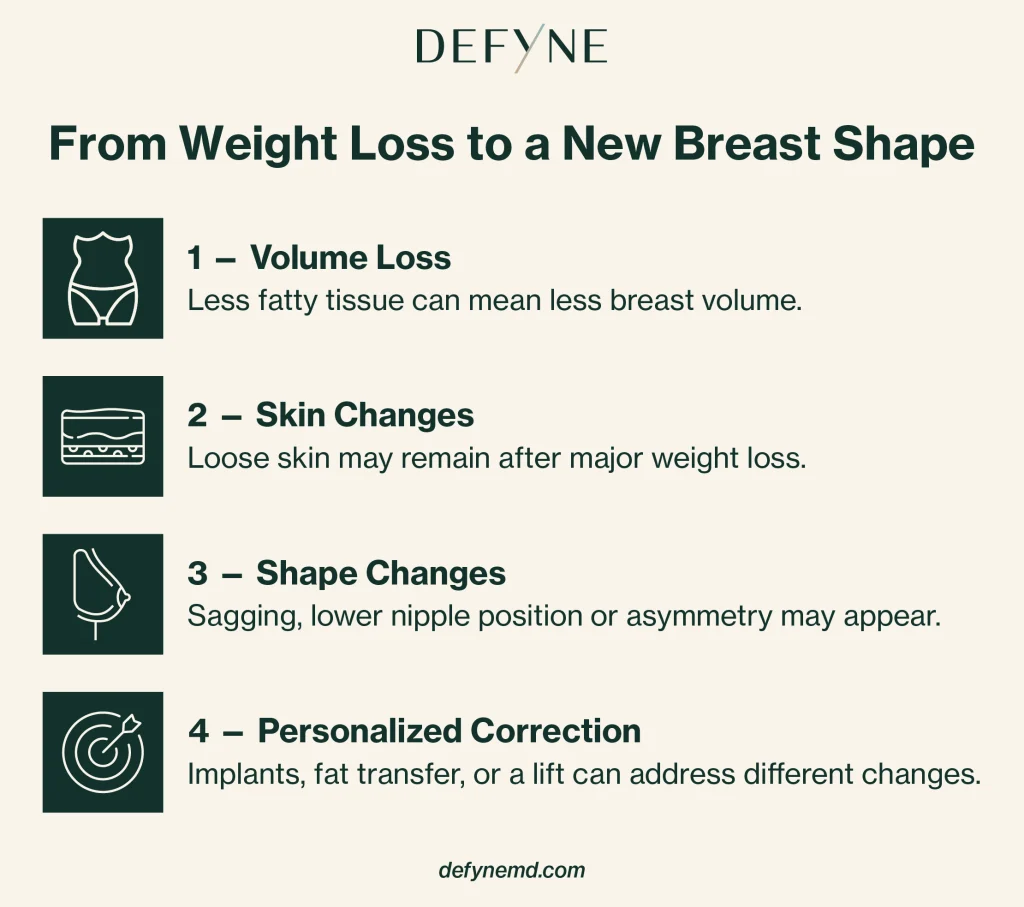
Breast tissue is made up of a combination of fatty tissue and fibroglandular tissue. With substantial weight loss, breast fat volume can decrease, along with fat volume in other body areas. Research shows that for every 20% decrease in BMI, as much as 25% of breast volume is also lost.
As volume decreases, excess skin can also sag—especially with rapid weight loss, which can occur after bariatric surgery or GLP-1 drugs. These changes can affect breast appearance, including ptosis (sagging), nipple position changes, and breast asymmetry.
Why a Stable Weight Matters Before Surgery
It’s important to know that further weight loss, weight gain, or recurring weight “see-saws” can continue to change breast volume, skin tension, and breast symmetry. Before considering breast augmentation options, plastic surgeons typically describe ideal candidates as those who:
- Have maintained a stable weight for at least six months, without plans for continued weight loss
- Are nonsmokers
- Have well-established lifestyle changes post-weight loss that include healthy nutrition, exercise, and good skin care
- Do not have significant or uncontrolled medical conditions
Timing for scheduling breast augmentation procedures should be individualized with support from weight-management and plastic surgery teams.
Comparing the Main Breast Augmentation Options
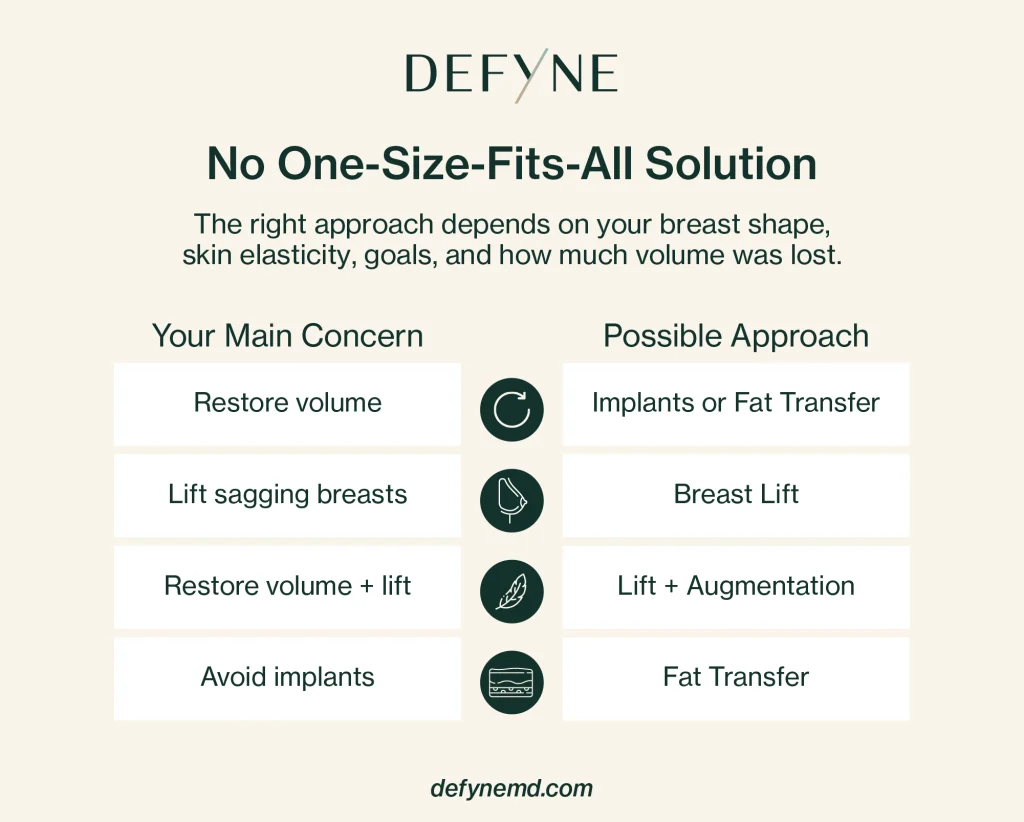
When choosing the best plan for breast augmentation after weight loss, consultation with a board-certified plastic surgeon should be your first step in creating a personalized journey. There are several factors that impact breast augmentation planning:
- Degree of breast sagging
- Skin elasticity
- Nipple position
- Whether asymmetry exists
- Desired final size
- Whether the patient would prefer to avoid implants
- Tolerance for scars
- Condition and amount of existing breast tissue
Let’s take a closer look at the options available for augmentation.
Breast Implants After Weight Loss
Traditional breast augmentation uses breast implants to increase volume and symmetry. This approach is best for a predictable increase in volume and for those seeking a dramatic volume increase and/or enhanced projection. Patients with minimal donor fat may also be better candidates for implants than fat transfer. Considerations include saline versus silicone implants, the best implant placement technique, and that breast implants require ongoing monitoring and have the potential to need future revision.
Fat Transfer Breast Augmentation
A minimally invasive alternative to traditional breast augmentation, fat transfer offers natural enhancement with minimal downtime and no implants, using the patient’s own harvested fat to increase breast volume. At Defyne, our signature True Shape Breast Augmentation offers Enhanced Viability Fat Transfer (EVFT) with advanced sculpting techniques designed to support fat-graft viability; final retention and results vary.
This approach is best for those who have adequate donor fat, are seeking a subtle to moderate increase in breast volume, would like to avoid implants and reduce scar appearance, and desire a natural look and feel.
Breast Lift After Weight Loss
A breast lift helps correct breast and nipple position that is caused by sagging breasts.
Depending on the degree of breast sagging, we can offer traditional breast lift surgery to correct significant breast drooping or our signature True Form Breast Lift for mild to moderate sagging, with little to no scarring and a faster recovery time.
Breast Lift with Augmentation
Because a breast lift alone only improves shape and sagging but does not improve volume, sometimes a combined procedure that includes breast lift with augmentation is the best approach. This can include adding breast implants or fat transfer breast augmentation to a breast lift, depending on patient goals and individual factors.
Expectations, Scars, Risks, and Recovery
Like any medical procedure, breast augmentation involves risk and recovery. Individual risk and recovery process depend on the procedure performed.
Risks of Breast Augmentation
Traditional augmentation with breast implants carries these risks, among others:
- Bleeding
- Infection
- Implant malposition
- Scarring and capsular contracture (scar tissue tightening around the implant)
- Skin wrinkling over the implant
- Changes in nipple or breast sensation
- Implant rupture, leakage, or need for revision
Fat transfer risks include infection, bleeding or a hematoma (a collection of blood), pain, partial fat reabsorption, fat necrosis, oil cysts, calcifications, and contour irregularities. Discuss how future breast imaging will be interpreted and whether further treatment might be needed.
Breast Augmentation Recovery
The final results of breast augmentation depend on the procedure used. While patients can expect improved proportions and breast contour, it’s important to understand that results may not be permanent. Further weight loss, weight gain, aging, or pregnancy-related changes can affect long-term outcomes.
The recovery timeline depends on the procedure and individual factors, but typical recovery timelines follow:
- Implant-based breast augmentation: 4-6 weeks, with about 5-7 days of initial downtime before returning to work.
- Fat transfer augmentation: plan for recovery at both the breasts and the liposuction donor sites. Bruising, swelling, and discomfort may last several weeks; return to work and exercise should follow individualized instructions. Final volume is assessed over the following months.
- Augmentation plus lift: Recovery from a traditional breast lift typically takes about 4-6 weeks. When combined with augmentation, the timeline depends on the procedures and your healing; follow your surgeon’s activity instructions.
Defyne’s True Shape Breast Augmentation and True Form Breast Lift offer results with little to no downtime and faster recovery than traditional approaches.
Scar patterns vary across procedures and techniques, with implant incision placement and lift approach affecting results. These scars mature over time and fade, but will remain permanent. Fat transfer is less invasive than traditional surgery and leaves minimal to no scarring.
Choosing the Right Approach
Breast augmentation after weight loss requires careful consideration, but support from an experienced plastic surgeon can help you create a personalized plan to achieve the best outcome possible.
Whether you choose a traditional breast augmentation with implants, a breast lift, fat transfer augmentation, or a combination of augmentation and a lift, improving breast contour and appearance after weight loss is a realistic aesthetic goal.
To explore traditional breast augmentation vs. minimally invasive procedures, contact Defyne today for a personalized consultation to help you learn more about the best option for you.
Contact Us
Request a Consultation
Are you ready to take the first step toward defining your destiny and achieving your best look yet? At Defyne, our board-certified plastic surgeons are skilled in performing both surgical and non-surgical procedures, achieving individualized, natural-looking results. Contact Defyne today to schedule your consultation appointment.